


Xeroderma pigmentosum
Xeroderma pigmentosum (XP) was first described in 1874 by Hebra and Kaposi. In 1882, Kaposi coined the term xeroderma pigmentosum for the condition, referring to its characteristic dry, pigmented skin. Xeroderma pigmentosum is a rare disorder transmitted in an autosomal recessive manner. It is characterized by photosensitivity, pigmentary changes, premature skin aging, and malignant tumor development. These manifestations are due to a cellular hypersensitivity to ultraviolet (UV) radiation resulting from a defect in DNA repair.

The most common defect in xeroderma pigmentosum is an autosomal recessive genetic defect whereby nucleotide excision repair (NER) enzymes are mutated, leading to a reduction in or elimination of NER. Unrepaired damage can lead to mutations, altering the information of the DNA in individual cells. If mutations affect important genes, such as tumour suppressor genes (e.g. p53) or proto oncogenes, then this disorder may lead to cancer. Patients exhibit elevated risk of developing cancer, such as basal cell carcinoma.
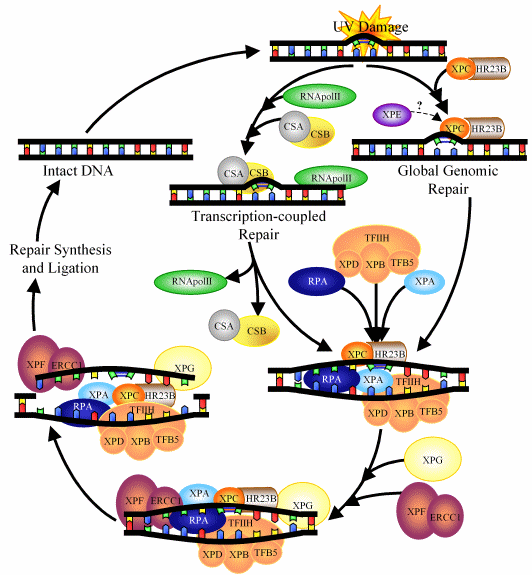
Normally, damage to DNA in epidermal cells occurs during exposure to UV light. The absorption of the high energy light leads to the formation of pyrimidine dimers, namely CPDs (cyclobutane-pyrimidine-dimers) and 6-4PPs (pyrimidine-6-4-pyrimidone photoproducts). The normal repair process entails nucleotide excision. The damage is excised by endonucleases, then the gap is filled by a DNA polymerase and "sealed" by a ligase.
Xeroderma pigmentosum (XP) was first described in 1874 by Hebra and Kaposi. In 1882, Kaposi coined the term xeroderma pigmentosum for the condition, referring to its characteristic dry, pigmented skin. Xeroderma pigmentosum is a rare disorder transmitted in an autosomal recessive manner. It is characterized by photosensitivity, pigmentary changes, premature skin aging, and malignant tumor development. These manifestations are due to a cellular hypersensitivity to ultraviolet (UV) radiation resulting from a defect in DNA repair.

The most common defect in xeroderma pigmentosum is an autosomal recessive genetic defect whereby nucleotide excision repair (NER) enzymes are mutated, leading to a reduction in or elimination of NER. Unrepaired damage can lead to mutations, altering the information of the DNA in individual cells. If mutations affect important genes, such as tumour suppressor genes (e.g. p53) or proto oncogenes, then this disorder may lead to cancer. Patients exhibit elevated risk of developing cancer, such as basal cell carcinoma.
Normally, damage to DNA in epidermal cells occurs during exposure to UV light. The absorption of the high energy light leads to the formation of pyrimidine dimers, namely CPDs (cyclobutane-pyrimidine-dimers) and 6-4PPs (pyrimidine-6-4-pyrimidone photoproducts). The normal repair process entails nucleotide excision. The damage is excised by endonucleases, then the gap is filled by a DNA polymerase and "sealed" by a ligase.

Xeroderma pigmentosum has an autosomal recessive pattern of inheritance.

SOURCES/REFERENCES:
1. Lippincott's Illustrated Reviews - Biochemistry - 3rd Edition
2. http://en.wikipedia.org
3. http://emedicine.medscape.com

1. Lippincott's Illustrated Reviews - Biochemistry - 3rd Edition
2. http://en.wikipedia.org
3. http://emedicine.medscape.com


